Rennes courtroom
An Officer and a SpyThe Rennes courtroom is the principal setting of the 1899 trial of Alfred Dreyfus, a public proceeding in which the room’s architecture made the conflict visible: military authority occupied the raised bench, lawyers faced one another below it, and the press filled much of the hall. The courtroom brought witnesses and the accused into close physical proximity, but it did not dissolve the institutional barriers between them. Its proceedings culminated in another guilty verdict, even as testimony there exposed the weakness and handling of important evidence.
Setting and Arrangement
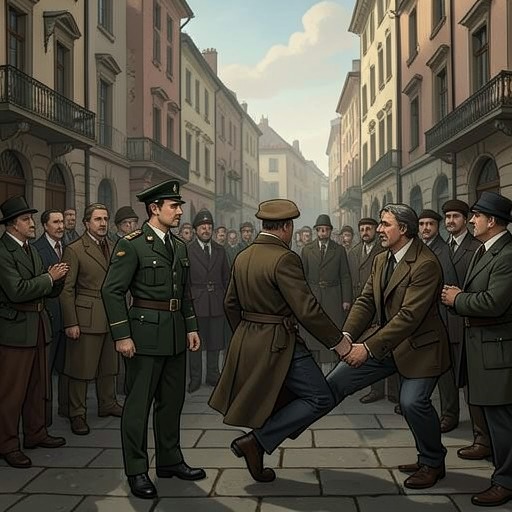
The route into the courtroom was controlled at several points. Georges Picquart and Edmond approached through streets lined with mounted gendarmes, had their papers checked, passed through a narrow entrance and then a cordon of infantry with fixed bayonets. The sequence of checkpoints made the hearing feel less like an ordinary public gathering than a guarded state proceeding. Inside, the security presence continued: infantry stood behind the public area at the rear.
The hall itself was approximately twenty metres long and fifteen metres wide, rising two storeys. Daylight entered through two tiers of windows on either side. At one end, a raised platform held a table and seven chairs with crimson backs; a plaster Christ on a black wooden cross hung behind them. Below the judges’ platform, prosecution and defence sat at opposing desks. Narrow tables and benches for the press ran along both sides of the room and were packed with reporters, whose numbers dominated the space. The public stood or sat at the back, while the central area was reserved for witnesses.
The room’s arrangement established a visible hierarchy. Judges occupied the elevated stage, the lawyers faced across the well of the court, and witnesses sat in a central position from which they could be examined but not freely approach the accused. The religious image behind the bench stood above proceedings framed in the language of military law and national defence; the account records its presence without suggesting that it altered the court’s conduct.
The Accused and the Witnesses
When the judges entered, led by Colonel Jouaust, the court ordered Alfred Dreyfus brought in. He appeared under escort, and the assembled room gasped at his changed appearance: he seemed markedly aged, small in his loose uniform, and moved with a stiff, difficult gait. He paused before climbing the steps to the platform, saluted the judges with a white-gloved hand, and removed his cap. The scene made the years of imprisonment legible in the courtroom, before testimony about his case began.
The witness area placed Picquart close to Dreyfus. When Picquart was called to testify, Dreyfus sat barely two metres away, near enough for a handshake, yet the rules and circumstances of the hearing kept them from speaking to one another. Picquart swore to tell the truth and faced the judges. The courtroom thus created an exacting physical proximity without personal access: the witness could address the court about Dreyfus while remaining unable to address Dreyfus himself.
The central space also gathered the military figures whose roles had shaped the affair. Boisdeffre, Gonse, Billot, Pellieux, Lauth, and Gribelin were present among the witnesses. Mercier entered later, passed Picquart without acknowledging him, and took a seat between Gonse and Billot, where the generals conferred in whispers. The arrangement of the room enabled the public to see these men assembled, but the narrative also records their avoidance of one another’s gaze and the return of Mercier to a leading role in the military case.
Testimony and Procedural Limits
Mercier’s appearance on the stand demonstrated how the hearing’s formal procedures could still produce an uneven examination. Edgar Demange questioned him about the falsified Panizzardi telegram held in the War Ministry archive and why it had not been included in the secret dossier shown to the judges. Mercier denied knowing about the falsification and said the telegram had been withheld because the Foreign Ministry would not have approved of its inclusion. Demange’s habit of prefacing questions with lengthy speeches gave Mercier time to prepare answers; Picquart judged that the questioning allowed the witness to brush aside the issues and leave the stand after only a short exchange.
The courtroom’s limitations became clearer after Maître Labori was shot. Labori survived the night, but the next time the court sat, Demange asked for a two-week adjournment so Labori could recover or another advocate could be fully briefed. Albert Clemenceau had agreed to take the case. Jouaust refused the request, ruling that the defence would have to continue as best it could despite the circumstances. The decision kept the proceeding moving while diminishing the defense’s ability to rely on its principal advocate.
The court also heard evidence about Dreyfus’s confinement on Devil’s Island. The account of the harsh regime embarrassed even prosecution witnesses Boisdeffre and Gonse. When Jouaust invited Dreyfus to comment, he limited his response to his determination to defend his honour and that of his children, declining to describe his suffering. In this crowded room, testimony could make the conditions of his imprisonment visible, but the accused chose not to make his pain the centre of his own defense.
Verdict and Significance
After the judges had deliberated for an hour and a half, the result was relayed to those awaiting news. The verdict was guilty by five votes to two, with the sentence reduced to ten years’ imprisonment. The courtroom therefore served as the setting for a public and consequential judgment, but publicity did not prevent the court from reaching a decision that sustained Dreyfus’s conviction.
The room’s crowded openness contrasts with the constraints visible within it. The press outnumbered other groups, the public was admitted behind a line of infantry, witnesses sat near the accused without being free to speak with him, and the defense’s request for time after Labori’s shooting was rejected. At the same time, testimony there brought the Panizzardi telegram and the treatment of Dreyfus on Devil’s Island into the proceeding. The courtroom could display evidence and disagreement without ensuring that they changed the verdict.
The later restoration of Dreyfus and Picquart belonged to a different setting and a later stage of the affair: on 13 July 1906, Picquart returned to the parade ground at the École Militaire for Dreyfus’s medal ceremony. That contrast gives the Rennes courtroom its particular significance. It was not the place where the case was finally resolved, but the site of a renewed conviction whose consequences would have to be challenged through further legal and political action.